Street Fight Defense Training in Gracie Barra Agoura Hills
In the tranquil suburbs of the Conejo Valley, the threat of street violence can seem distant. However, Gracie Barra Agoura Hills (GBAH) operates on the principle that preparation for chaos is the best insurance policy.
While Brazilian Jiu-Jitsu (BJJ) has exploded in popularity as a professional sport and fitness trend, the academy in Agoura Hills remains firmly rooted in the original mission of the Gracie family: teaching effective, reality-based self-defense to the average person.
The training at GBAH is not about winning trophies, scoring points, or performing flashy moves seen in movies. It is about surviving an unscheduled, violent encounter in the real world against an aggressive, potentially larger adversary.
Here is a detailed breakdown of every aspect of street fight defense training at Gracie Barra Agoura Hills.
- The Core Philosophy: The Reality of the Street Fight
The training begins with a mindset shift. Instructors at GBAH emphasize that a street fight is fundamentally different from a sport BJJ match or an MMA bout.
No Rules, No Referees: There are no time limits, no points for cool moves, and no illegal strikes. The pavement is unforgiving.
The Asymmetric Threat: In a real assault, the attacker is almost always larger, stronger, younger, or part of a group. They are the ones initiating the violence.
The Failure of Striking: GBAH teaches that trying to out-punch a larger, heavier attacker is a losing strategy for most people. One mistake against a powerful striker ends the fight.
Therefore, the GBAH system focuses on neutralizing size and strength advantages by taking the fight to the ground, where leverage and technique dominate brute force.
- The Curriculum Structure: The “GB1” Foundation
Street defense is not reserved for advanced black belts. It is the very first thing taught.
Gracie Barra Agoura Hills utilizes a highly structured, standardized curriculum. New students enter the GB1 Fundamentals Program. This program is approximately 16 weeks of rotating lessons dedicated almost exclusively to street self-defense scenarios.
Before a student ever worries about complex sport guards like “De la Riva” or “Berimbolo,” they must master the essentials of surviving a headlock, escaping a bear hug, and defending against punches. This structure ensures that even a student with only a few months of training has a functional toolbox for survival.
- The Anatomy of Street Defense Training
The training covers the entire timeline of a confrontation, from pre-fight awareness to ending the threat.
Phase A: The Pre-Fight (Awareness and De-escalation)
The best defense is avoiding the fight. GBAH teaches situational awareness—how to scan environments like parking lots or ATMs—and the importance of verbal de-escalation.
The Defensive Stance: Students learn to adopt a non-threatening posture with hands open and up near the face. This serves a dual purpose: it visually signals “I don’t want trouble,” but the hands are already in position to block a surprise sucker punch.
Phase B: Closing the Distance (Surviving the Strikes)
If de-escalation fails and punches are thrown, GBAH teaches that the safest place to be is actually closer to the attacker, not further away.
The “Crash”: Standing at the end of an attacker’s punching range is dangerous. Students learn to cover their heads, change levels, and aggressively close the distance to “clinch” (wrap their arms around) the attacker. By gluing themselves to the attacker’s torso, they neutralize the power of punches and kicks.
Phase C: The Takedown (Controlling the Environment)
Once clinched, the fight must go to the ground to utilize BJJ.
Safe Takedowns: GBAH does not emphasize high-amplitude judo throws or complex wrestling shots that might expose the student’s neck to a guillotine choke or cause injury on concrete. Instead, they teach highly effective, low-risk takedowns—often using body folds or simple leg trips—designed to bring the attacker down while the student remains in a dominant position.
Phase D: Ground Survival (The Worst-Case Scenario)
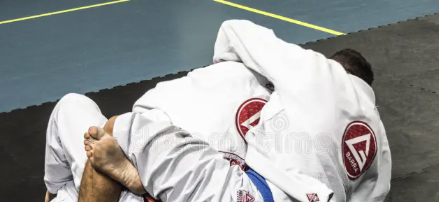
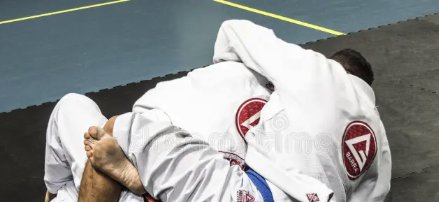
This is the core of the training. The assumption is that you have been tackled or knocked down and a heavier attacker is on top of you.
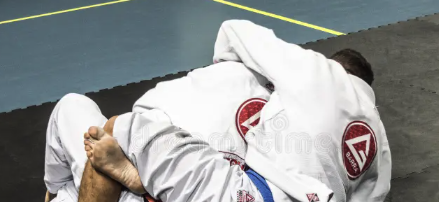
Escaping the Mount: Students drill relentlessly on how to escape when someone is sitting on their chest, using the “trap and roll” (Upa) technique based on hip leverage, not bench-pressing strength.
The Guard: If on their back, students learn to use their legs (the “Guard”) as a shield to manage distance, block incoming punches, and set up sweeps to reverse the position.
Headlock Escapes: The “schoolyard headlock” is a common street attack. GBAH teaches precise mechanical steps to frame against the neck, create space for breathing, and escape the hold before being choked unconscious.
Phase E: Ending the Threat (Submission vs. Control)
GBAH teaches a “sliding scale of force” suitable for the legal realities of Agoura Hills.
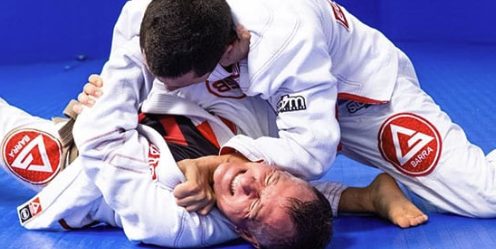
Control: Sometimes, the goal is simply to pin an attacker to the ground (like an intoxicated relative or a confused aggressor) without injuring them until police arrive.
Submission: If the threat is lethal, students are taught blood chokes (like the Rear Naked Choke) to render an attacker unconscious in seconds, or joint locks to incapacitate a limb if absolutely necessary.
- The Training Environment: The “Laboratory”
How do you train for a violent, chaotic event safely? GBAH uses a methodology of progressive resistance.
Drilling: First, techniques are learned against a compliant partner to understand the mechanics.
Positional Sparring: Next, students start in a bad spot (e.g., under a headlock) with a resisting partner and have to escape using only technique while the partner tries to hold them down.
Live Rolling: Finally, students engage in full sparring (“rolling”). This provides “stress inoculation.” It teaches students to remain calm, breathe, and think clearly when exhausted and under pressure—exactly what is required in a real fight.
- The “Gi” as a Street Tool
Students at GBAH train primarily in the traditional Kimono (Gi). While it looks like a uniform, for street defense, the Gi represents everyday clothing.
A thick Gi collar simulates a winter jacket; the sleeves simulate a heavy hoodie or denim shirt. GBAH teaches students how to use an attacker’s own clothing against them—using their jacket collar to choke them or their sleeve grip to control their posture.
Street fight defense training at Gracie Barra Agoura Hills is about replacing panic with a plan. It is a comprehensive, structured system designed to give regular people the physical tools and mental fortitude to survive the worst 60 seconds of their lives against a bigger, stronger, untrained aggressor.
Hours
Mon-Thurs: 12 PM to 9 PM
Fridays: 12 PM to 7 PM
Saturdays: 9 AM to 2 PM
Sundays: CLOSED
Contact
Phone Number: +1 805-800-9681
info@gbnorthridge.com
Location
19520 Nordhoff St Unit 10 Northridge, CA 91324

Street Fight Defense Training in Gracie Barra Agoura Hills

Route
Gracie Barra Agoura Learn Brazilian Jiu Jitsu
Secondary phone: +1 805-800-9681
Email: info@gbagoura.com
URL: https://gbagoura.com/
| Monday | 12:00 PM - 8:00 PM |
| Tuesday | 12:00 PM - 8:00 PM |
| Wednesday | 12:00 PM - 8:00 PM |
| Thursday | 12:00 PM - 8:00 PM |
| Friday | 12:00 PM - 1:00 PM |
| Saturday | 10:00 AM - 12:30 PM |
| Sunday | Closed |