Close Combat Training Agoura Hills: Gracie Barra Agoura
Gracie Barra Agoura (GBA), located in the suburban landscape of the Conejo Valley, is not a military combatives center or a “reality-based self-defense” studio that teaches eye gouges and throat strikes.
When discussing “Close Combat Training” in the context of Gracie Barra Agoura, it refers specifically to the application of Gracie Brazilian Jiu-Jitsu (BJJ) as a complete system for managing, surviving, and ending an unarmed physical altercation that has entered direct physical contact range.
The premise of the training is that while you should always try to de-escalate or flee, if you are forced to fight, the encounter will almost inevitably crash into a clinch and end up on the ground. GBA specializes in dominating that exact scenario.
Here is a detailed breakdown of the philosophy, curriculum, mechanics, and environment of close combat training at this academy.
- The Core Philosophy: Grappling as the Ultimate Close Combat Tool
The instructors at Gracie Barra Agoura operate on a foundational belief drawn from decades of real-world data (including early UFC events and law enforcement statistics): Striking is unreliable; grappling is inevitable.
In a close-quarters street fight, relying on punching power is a gamble. If the attacker is larger, on drugs, or just tougher, your punches may not stop them. Furthermore, throwing a punch opens you up to being clinched, tackled, or knocked out yourself.
Therefore, the GBA close combat philosophy focuses on:
Closing the Distance: Instead of standing in the “striking zone” where you can be hit, you are taught to safely crash the distance and attach yourself to the attacker. You are safer “hugging” someone trying to punch you than standing two feet away from their fist.
Leverage Over Strength: The system assumes the attacker will be larger and stronger. GBA teaches the use of physics—levers, wedges, and fulcrums—to control a bigger person’s body rather than trying to out-muscle them.
The Ground is the Equalizer: The ultimate goal of close combat at GBA is often to take the fight to the ground on your own terms. Once on the ground, an untrained attacker’s size advantage is significantly diminished, and technical BJJ knowledge becomes the deciding factor.
- The Curriculum Structure: The “GB1” Foundation
Close combat training is not reserved for elite students; it is the first thing taught to beginners.
Gracie Barra Agoura utilizes a standardized, highly structured curriculum. New students enter the GB1 Fundamentals Program. This 16-week rotating curriculum is laser-focused on essential self-defense scenarios. Before a student learns complex sport Jiu-Jitsu moves, they must master the basics of surviving a headlock, escaping a bear hug, and defending against punches while on the ground.
This structured approach ensures that every student possesses a functional toolkit for close-quarters survival within their first few months of training.
- The Tactical Anatomy of Close Combat
The training breaks down a violent encounter into distinct phases, providing solutions for each.
Phase A: The Pre-Contact Zone (Distance Management)
Before combat becomes “close,” it is usually at a talking distance. GBA teaches how to manage this “Red Zone.”
The Defensive Posture: Students learn to stand in a non-aggressive stance with hands open and raised near the chest or face. This allows for verbal de-escalation (“Hey, I don’t want any trouble”) while ensuring the hands are ready to block a sudden sucker punch.
Phase B: The Clinch (Surviving the Strikes)
If de-escalation fails and the attacker becomes violent (throwing a punch or trying to shove), GBA teaches immediate engagement.
Changing Levels and Covering: Students learn to drop their center of gravity, use their arms as a “helmet” to protect their head, and aggressively move forward.
The Clinch: The goal is to wrap around the attacker’s torso or hips. Once clinched, the attacker cannot generate effective power for strikes. You have neutralized their primary weapon by getting too close.
Phase C: The Takedown (Controlling the Environment)
Once connected to the attacker, the student is taught to take the fight to the floor.
High-Percentage, Low-Risk Takedowns: GBA does not emphasize flashy, high-amplitude throws that risk injury on pavement. They teach efficient takedowns—such as body-lock folds or simple leg trips—designed to bring the attacker down decisively while ensuring the student lands in a dominant top position.
Phase D: Ground Survival (The Worst-Case Scenario)
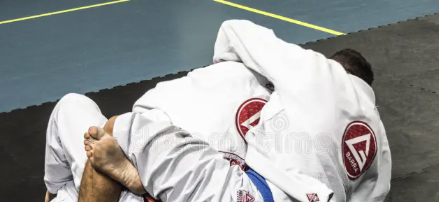
This is the heart of BJJ and the most critical aspect of close combat training. The assumption is that you have been tackled or knocked down, and a heavier attacker is on top of you.
Escaping the Mount: If an attacker is sitting squarely on your chest, panic is fatal. GBA teaches the “Trap and Roll” (Upa), a leverage-based escape using powerful hip bridging to reverse the position.
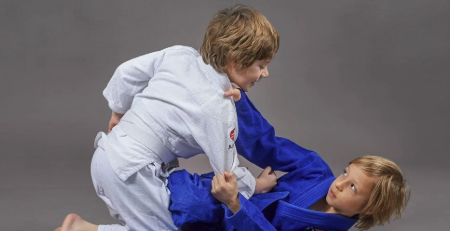
The Guard: If you are on your back, you learn to use your legs (wrapping them around the attacker or placing feet on their hips) as a shield to manage distance, block punches, and off-balance the attacker.
Headlock Escapes: The most common untrained attack is the schoolyard headlock. GBA teaches precise mechanical steps to frame against the attacker’s neck, create breathing room, and escape the hold without relying on strength.
Phase E: Ending the Threat (Submission vs. Control)
GBA teaches a “sliding scale of force” suitable for civilian self-defense.
Control and Wait: Sometimes the goal is simply to pin an aggressor to the ground without hurting them until they calm down or police arrive.
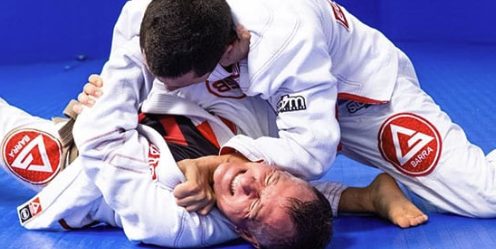
Decisive Incapacitation: If the threat is grave, students learn blood chokes (like the Rear Naked Choke) that render an attacker unconscious in seconds without causing permanent injury, or joint locks to break a limb if absolutely necessary.
- The Training Methodology: Stress Inoculation
Gracie Barra Agoura bridges the gap between theory and reality through “live” training. You cannot learn to swim without getting wet, and you cannot learn close combat without physical resistance.
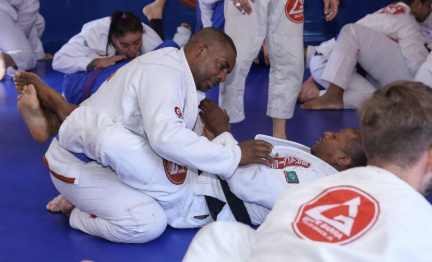
Drilling: Techniques are first learned on a compliant partner to understand the mechanics.
Positional Sparring: Students are placed in specific bad spots (e.g., pinned under mount) and must escape using only technique while their partner applies moderate, controlled resistance to hold them down.
Live Rolling: Finally, students engage in full grappling sparring (“rolling”). This provides “stress inoculation.” It teaches students to remain calm, breathe, and think clearly when exhausted, crushed, and under pressure—exactly what is required in a real close-combat scenario.
- The Environment and Culture
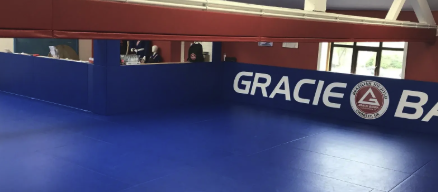
The close combat training at GBA occurs in a specific environment designed for safety and longevity.
The “Gi” as a Tool: Students train primarily in the traditional Kimono (Gi). In a self-defense context, the thick collar simulates a jacket, and the sleeves simulate heavy clothing. Students learn how to use an attacker’s own clothes against them to choke or control them.
Safety First: While the training is intense, the culture at GBA is professional and respectful. “Ego” is discouraged. The goal is to learn to be dangerous without injuring your training partners.
Close combat training at Gracie Barra Agoura is not a collection of “dirty tricks.” It is a systematic, scientifically proven approach to surviving unarmed violence. By focusing on clinch work, ground survival, and the application of leverage, it provides average people in the Agoura Hills community with the physical tools and mental resilience to handle intense, close-quarters aggression.
Hours
Mon-Thurs: 12 PM to 9 PM
Fridays: 12 PM to 7 PM
Saturdays: 9 AM to 2 PM
Sundays: CLOSED
Contact
Phone Number: +1 805-800-9681
info@gbnorthridge.com
Location
19520 Nordhoff St Unit 10 Northridge, CA 91324
Close Combat Training Agoura Hills: Gracie Barra Agoura
Route
Gracie Barra Agoura Learn Brazilian Jiu Jitsu
Secondary phone: +1 805-800-9681
Email: info@gbagoura.com
URL: https://gbagoura.com/
| Monday | 12:00 PM - 8:00 PM |
| Tuesday | 12:00 PM - 8:00 PM |
| Wednesday | 12:00 PM - 8:00 PM |
| Thursday | 12:00 PM - 8:00 PM |
| Friday | 12:00 PM - 1:00 PM |
| Saturday | 10:00 AM - 12:30 PM |
| Sunday | Closed |